

CUSTOMERS are calling out for retail pharmacies to improve their store design and become more accessible, writes senior editor and advocacy manager Rosemary Ainley from patient-support group GHLF Australia.
Got an opinion or experience to share? Let us know in up to 400 words via email to info@pharmacydaily.com.au.
Your regular pharmacy clients are, no doubt, those with disabilities and chronic conditions.
So, how easy is it for them to access your services?
Global Healthy Living Foundation (GHLF) Australia and CreakyJoints Australia support and empower people with chronic conditions.
We asked our patient communities whether they had ever had difficulty using retail pharmacies and received a flood of responses.
While some reported positive experiences, especially at smaller pharmacies, many found it harder to access busy stores.
As one person put it, "'Have I found it easy to use one?' would be a better question."
For some, barriers arise before they even enter the store.
"Most discount pharmacies in the CBD are underground and have no public elevator access, essentially preventing access for mobility-impaired people - how is that even legal?" said Karina.
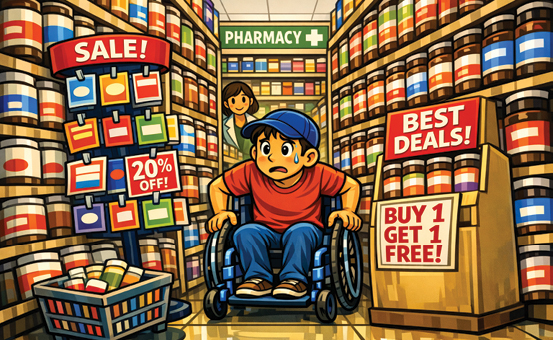
The most common issue raised was poor store and fixture design.
"Most of the chain pharmacies are packed with display stands," Kate observed.
"The narrow aisles and super-high shelving don't allow someone using mobility aids to navigate through the shop easily, if at all," she noted.
"The hike to the prescription dispensary, which is always at the back of the store, can be so difficult," concurred Emma.
"I would like to see lowered prescription counters for wheelchair users as display units often block access to the regular counters," Carol suggested.
"No seats while waiting for scripts [can be an issue for] sick, elderly and disabled people who can struggle with standing," Laura pointed out.
"And tall counters are not fun for short people," she added.
Sensory overload was another common theme.
"The checkout area is packed with products, advertising and signs - having all that right in my eyeline makes it difficult to see the staff member and to concentrate on the interaction," Jessica said.
"Some offer quiet times on weekday mornings, but many disabled adults are at school, work and other places at that time," noted Kylie.
"We need to move away from the whole 'disabled people don't work' thing and make quiet times available on weekends and evenings," she suggested.
"It feels like a cruel trick to fill a prescription for my migraine medications only to have a migraine attack triggered by the bright lights and heavily perfumed air," Pippa said.
"The noise from crowds and TVs spouting ads is cacophonous - I wonder if some pharmacies would pass an accessibility audit?" asked Ruth.
Beyond physical and sensory barriers, inaccessible pharmacies can limit access to affordable medicines and health products, raising serious equity concerns.
Our question for pharmacy staff and owners is clear: how can you do better?
For more on GHLF Australia, visit its website at ghlf.org.au.
The above article was sent to subscribers in Pharmacy Daily's issue from 13 Feb 26
To see the full newsletter, see the embedded issue below or CLICK HERE to download Pharmacy Daily from 13 Feb 26